Choosing a random number can be useful in many everyday situations. Whether you need a number for a game, classroom activity, challenge, decision, or simple selection, an online tool can make the process quick and easy.

To pick a random number online, you simply decide the range of numbers you want to choose from and use a random number generator or number selection tool to produce a result. For example, you might choose a number from 1 to 10 for a small activity, select from 1 to 100 for a larger range, or use a number wheel for a more interactive experience.
The key is deciding the available range before making the selection. Once the possible numbers are clear, an online randomizer can help choose one option without manually picking it yourself.
Random numbers are commonly used for:
- Games and activities
- Classroom exercises
- Choosing participants
- Creating challenges
- Selecting tasks
- Making simple everyday decisions
- Random selections from numbered lists
This guide explains what random numbers are, how online number tools work, how to choose the right range, and practical ways to use them.
What Does It Mean to Pick a Random Number?
To pick a random number means selecting one number from a group of possible numbers without intentionally choosing a specific result.
For example, if you want to choose a number from 1 to 10, the available options are:
- 1
- 2
- 3
- 4
- 5
- 6
- 7
- 8
- 9
- 10
A random selection chooses one number from this range.
People use random numbers because they provide a simple way to make selections when there are several possible options.
Some common examples include:
- Choosing who goes first in a game
- Selecting a numbered item from a list
- Creating a random challenge
- Picking a classroom activity
- Assigning participants numbers
- Choosing between different options
The range of numbers is an important part of the process. A number selection from 1 to 5 works differently from a selection from 1 to 100 because the available choices are different.
For example:
- A small range may work well for quick decisions.
- A medium range may work well for activities and games.
- A larger range may be useful when many possible results are needed.
Online tools make this process easier because you do not need to manually write numbers, shuffle cards, or decide the result yourself.
How to Pick a Random Number Online
The easiest way to pick a random number online is to use a random number tool that allows you to select a range and generate a result.
The general process is simple.
1. Decide the minimum number
First, choose the lowest number that should be included.
Examples:
- Starting at 1
- Starting at 0
- Starting at another number depending on your activity
For many everyday activities, people commonly start with 1.
2. Decide the maximum number
Next, choose the highest possible result.
Examples:
- 1 to 6 for dice-style activities
- 1 to 10 for a small selection
- 1 to 50 for a larger choice
- 1 to 100 for a wider range
The maximum number should match the number of available options.
3. Select the number range
Enter or select the range you want to use.
For example:
- Minimum: 1
- Maximum: 100
This tells the random number tool which results are possible.
4. Generate or select the result
After the range is defined, generate the result.
The tool selects one available number from the chosen range.
The result can then be used for your activity, game, or decision.
5. Use the selected number
The final step is deciding what the number represents.
Examples:
- Number 3 represents the third option on a list.
- Number 8 represents a selected player.
- Number 25 represents a challenge or activity.
A random number generator is most useful when the numbers have a clear purpose.
Using a Random Number Wheel
A random number wheel provides a visual way to select numbers.
Instead of simply displaying a result, a spinning wheel shows the selection process. Users can watch the wheel move and stop on a chosen number.
A number wheel can be useful for:
- Games
- Classroom activities
- Group activities
- Challenges
- Simple decisions
- Choosing participants
- Random selections
For example, a teacher could create a numbered activity list and use a wheel to select which activity happens next.
A group playing a game could use a number wheel to decide turns or select a challenge.
A family could use one to choose between different numbered activities.
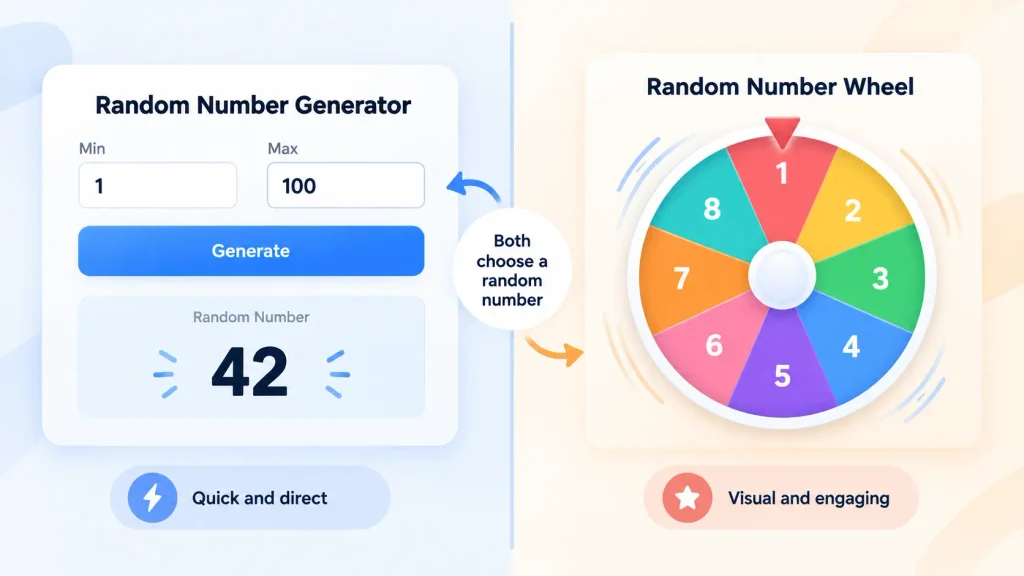
The main difference between a basic number generator and a wheel is the experience. A generator usually provides a direct result, while a wheel adds a visual and interactive element.
Both methods can be useful depending on the situation.
A number generator may be better when speed is the priority. A wheel may be more engaging when the selection process is part of the activity.
Popular Random Number Ranges
Different activities require different number ranges. Choosing the correct range helps make the result useful.
1–4
A range from 1 to 4 works well when there are only a few possible options.
Examples:
- Choosing between four activities
- Selecting one of four choices
- Creating a simple game mechanic
- Assigning one of four categories
A smaller range keeps the selection simple and easy to understand.
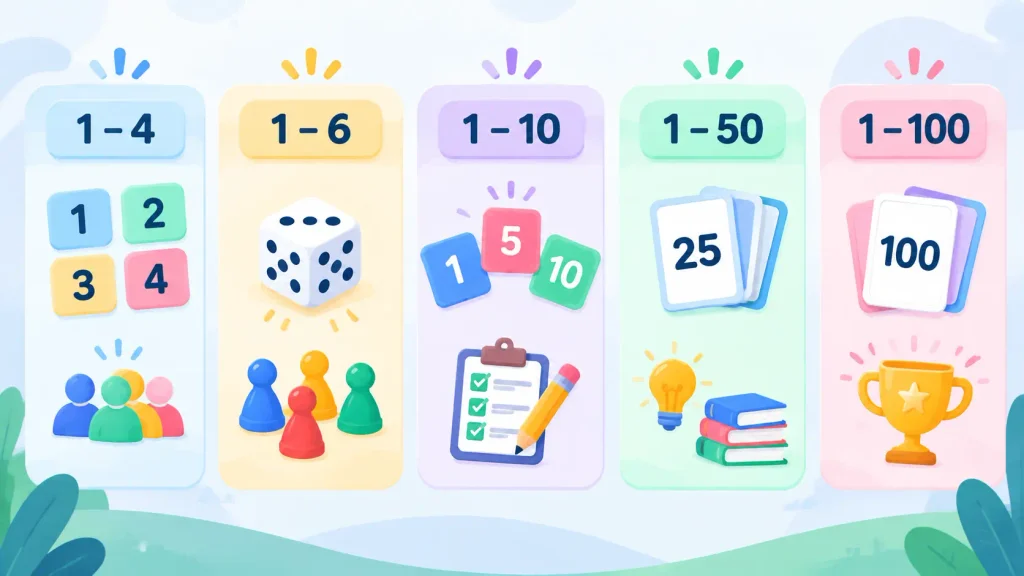
1–6
A range from 1 to 6 is commonly used for dice-style activities.
Examples:
- Board games
- Turn selection
- Classroom games
- Number challenges
Many activities use six possible results because it matches the familiar structure of a standard die.
A random number selection from 1 to 6 can provide a simple digital alternative for activities that need dice-style results.
1–10
A range from 1 to 10 is one of the most common choices for quick selections.
Examples:
- Rating activities
- Choosing a numbered option
- Selecting a task
- Creating challenges
- Simple decisions
A 1–10 range is easy for most people to understand because it provides enough variety without creating too many choices.
1–50
A range from 1 to 50 provides more possible results.
This can be useful for:
- Larger games
- Number challenges
- Group activities
- Selecting from a numbered list
For example, if each participant has a number assigned, a larger range can help select from more people or options.
1–100
A range from 1 to 100 is useful when you need a broader selection.
Examples:
- Larger activities
- Number-based games
- Random challenges
- Selecting from many possible choices
A random number from 1 to 100 is often used because it provides a wide range while still being easy to understand.
Ways to Use a Random Number Generator
A random number generator can be useful whenever you need to select a number without manually choosing one. The purpose of the number depends on the activity and how the result will be used.
Here are some practical examples.
1. Choosing a Game Option
Games often include numbered choices, levels, characters, or challenges.
A random number can help select:
- A game category
- A challenge number
- A numbered item
- A player option
- A random event
For example, a group could create a list of ten game challenges and use a random number generator to select which challenge happens next.
2. Selecting a Participant
When several people are involved, random numbers can help choose someone.
Examples:
- Selecting a player
- Choosing a volunteer
- Assigning a turn
- Picking a participant from a numbered list
One simple method is assigning each person a number and generating a result.
3. Deciding the Order of Activities
Random numbers can help decide which activity happens first.
Examples:
- Choosing presentation order
- Selecting a group task
- Organizing game rounds
- Arranging activity sequences
A numbered list combined with a random selection can make organizing easier.
4. Picking a Number for a Challenge
Many activities use random numbers as part of the experience.
Examples:
- Selecting a challenge level
- Choosing a question number
- Picking a task
- Creating a surprise activity
The number itself may represent something else, depending on the list you create.
5. Choosing a Classroom Activity
Teachers can use random numbers for educational activities.
Examples:
- Selecting a question
- Choosing an exercise
- Assigning a student number
- Picking a topic from a numbered list
A random selection can add variety to classroom exercises.
6. Creating a Random Writing Prompt Number
Writers and students can use numbers to organize creative ideas.
For example:
- Create a list of writing prompts.
- Assign each prompt a number.
- Generate a random number.
- Use the matching prompt.
This creates a simple way to start a creative activity.
7. Selecting a Task From a Numbered List
If you have several tasks to complete, assigning numbers can make choosing easier.
Example:
- Clean desk
- Organize files
- Read a chapter
- Complete an exercise
A random number can select which task to start with.
8. Making a Simple Everyday Decision
For casual decisions, numbers can help narrow down options.
Examples:
- Choosing between restaurants
- Selecting an activity
- Picking a numbered option
- Deciding which item to try first
Random selection works best when the available choices are already acceptable.
9. Choosing a Random Item From a List
You can assign numbers to items and let the generator choose one.
Examples:
- Books to read
- Recipes to try
- Movies to watch
- Activities to complete
The number becomes a shortcut for selecting from the list.
10. Creating Random Game Outcomes
Games can use random numbers to introduce variety.
Examples:
- Selecting turns
- Creating events
- Choosing rewards
- Assigning challenges
A random number generator for games can be useful when you need a quick selection method.
Random Number Generator vs. Random Number Wheel
Both a random number generator and a random number wheel can help select numbers, but they provide different experiences.
A generator focuses on quickly producing a number result, while a wheel adds a visual spinning experience.
| Feature | Random Number Generator | Random Number Wheel |
|---|---|---|
| Main purpose | Quickly select a number | Select a number through a visual spin |
| Experience | Simple and direct | Interactive and engaging |
| Best suited for | Fast selections and number ranges | Games, activities, and group experiences |
| Setup | Usually requires defining a range | Often uses visible wheel sections |
| Result display | Shows the selected number | Shows the wheel stopping on a selection |
Neither option is automatically better. The right choice depends on what you need.
A generator may be useful when you only need a number quickly.
A wheel may be better when the selection process itself is part of the activity.
How to Choose the Right Number Range
Choosing the correct number range is an important step when using a random number tool.
The range should match the choices you want to include.
Choosing One Person From a Group
Imagine you have 10 participants.
You could assign each person a number:
- Person 1
- Person 2
- Person 3
- Up to Person 10
A range from 1 to 10 would match the available choices.
Selecting a Number for a Game
Games often require specific ranges.
Examples:
- Dice-style activity → 1 to 6
- Ten possible actions → 1 to 10
- Larger challenge list → 1 to 50 or 1 to 100
The range should represent the available game options.
Choosing From a Numbered List
If you create a list of 25 items, a range from 1 to 25 makes sense.
Examples:
- 25 activity ideas
- 25 questions
- 25 challenges
The selected number corresponds to the matching item.
Classroom Activities
Teachers can use ranges based on the number of available choices.
Examples:
- 1–20 for students
- 1–10 for questions
- 1–30 for activities
The important part is making sure every intended option has a number.
Decisions Between Options
For simple choices, assign each option a number.
Example:
- Watch a movie
- Play a game
- Go outside
- Read a book
A number selection from 1 to 4 can choose one option.
Tips for Picking a Random Number
A random selection works best when the setup is clear.
Here are some practical tips:
Define the range before generating the result
Decide the minimum and maximum numbers first.
For example:
- Minimum: 1
- Maximum: 50
This prevents confusion about which numbers are available.
Check the minimum and maximum values
Make sure the range matches your purpose.
For example, if you only have ten options, using a range that goes much higher may create results that do not match your list.
Avoid changing the range after seeing the result
If you are using a random selection for an activity, decide the rules before generating the number.
Changing the options afterward can make the process less consistent.
Use the same rules for everyone in group activities
If multiple people are participating, make sure everyone understands:
- The number range
- What each number represents
- How the result will be used
Clear rules make activities easier to follow.
Keep choices clearly defined
Make sure each number represents a clear option.
For example:
Good:
- Play a card game
- Watch a movie
- Cook a meal
Less clear:
- Something fun
- Another option
- Something else
Make sure every intended option is represented
Before generating a number, check that all choices you want included have been assigned correctly.
Random Numbers for Games and Activities
Random numbers can make games and activities more varied by introducing unexpected selections.
They can be used for:
Choosing turns
Players can be assigned numbers, and a random result can decide the order.
Selecting players
A number can represent a participant in a group activity.
Assigning numbered tasks
Create a list of tasks and let the number decide which one is selected.
Selecting game options
Numbers can represent:
- Characters
- Levels
- Challenges
- Categories
- Questions
Determining an order
A random number can help organize:
- Presentations
- Activities
- Rounds
- Team selections
Choosing challenges
Games can use numbered challenges for variety.
Examples:
- Challenge 1
- Challenge 2
- Challenge 3
A random selection chooses the next activity.
Classroom activities
Teachers can use numbers for:
- Questions
- Students
- Exercises
- Topics
Party activities
Groups can use random numbers for:
- Games
- Activity selection
- Team choices
- Turn order
Random numbers are especially useful when everyone agrees on the available options before the selection happens.
Frequently Asked Questions
How do I pick a random number online?
You can pick a random number online by choosing a number range and using a random number generator or picker to select one result.
What is the easiest way to generate a random number?
The easiest method is to decide your range, enter the minimum and maximum values, and generate a result using an online random number tool.
Can I pick a random number between two numbers?
Yes. Most random number tools allow you to define a minimum and maximum value so you can choose a number within a specific range.
What can I use a random number generator for?
A random number generator can be used for games, classroom activities, simple decisions, selecting tasks, choosing participants, and random selections.
Can I use a random number wheel for games?
Yes. A random number wheel can add a visual and interactive element to games by selecting numbers through a spinning process.
Can I generate a random number from 1 to 100?
Yes. A random number tool can be used to select a number within a 1–100 range when that matches your activity.
What is the difference between a random number generator and a random number wheel?
A random number generator usually provides a direct number result, while a random number wheel presents the selection as a visual spinning experience.